And, while a record breaker is always exciting, I wasn’t able to find a great video of it, so it wasn’t *that* exciting. To be honest*, I haven’t slept since I found that low quality video, especially after Rob and Sarah from Belts & Boxes viciously attacked it on the weekly YouTube show Week in Review. But, fear not, I have not only found a better quality video, I’ve also found some behind the scenes footage of how it was carried out.
In total, there were 5 buildings demolished as part of the Mina Plaza, totaling 125 stories, which were razed to make way for a redevelopment. Safedem, the demolition contractor that carried out the implosion, performed a test blast to make sure their models and designs were accurate before the final blasts.
There’s no doubt that this past year has been a constant back and forth of confusion surrounding the best way to protect yourselves and others from the spread of COVID-19. Incomplete studies and misinformation spread hasn’t helped much either, but some things do take time to properly sort out. A recent published study, which was carried out by a team of researchers from NIOSH and has been endorsed by the CDC, has concluded that neck gaiters can be an effective form of control.
Neck gaiters are a popular choice for the construction industry because they can be more comfortable than other masks over long periods of time, can be more versatile, and some even made with a cooling fabric.
To reflect the results of this study, the CDC has updated their Guide to Masks to recommend the use of double layered neck gaiters as a mask. As you can imagine from reading the chart above, the study – and subsequently the CDC – do not recommend the use of face shield to prevent the spread of the virus.
The study also underlines the fact that cloth masks and neck gaiters are meant to protect other people, not the wearer, from the spread of large respiratory aerosols, which are airborne liquid droplets and dried particles that are spread through talking, singing, coughing, breathing, or sneezing. COVID-19 can be carried through these droplets of an infected person.
It’s important to note that cloth masks and neck gaiters are not considered PPE and can not be used in place of respirators for construction tasks that require them, such as concrete demolition.
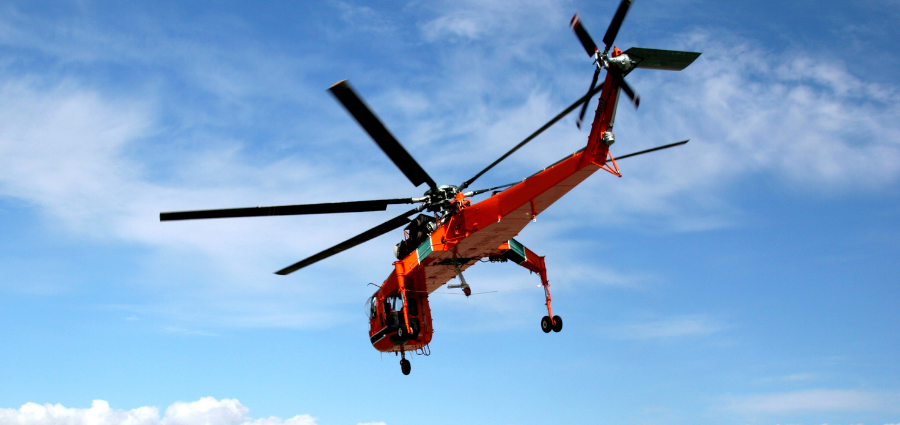
If you need to get some heavy mechanical equipment on the roof of your project, you could use a boring old crane – or you could gas up the bird and make that equipment take literal flight. Alright, so cranes aren’t actually boring, but some times a helicopter makes more logistical sense, either because it reduces total lift time or, in some cases, makes economical sense. Either way, there are some important safety precautions to take in case something goes wrong.
During a recent helicopter lift in Oakland, California, something did go wrong, but luckily, it appears that no one was injured – at least not until someone found out what happened to their large, expensive industrial cooling tower.
According to The Mercury News, a Sikorsky S-64 Skycrane was being used throughout the week to lift mechanical equipment to the roof of a construction project on Clay Street in Oakland, when a cable suddenly snapped, sending what appears to be a large cooling tower made by Baltimore Air Coil (BAC) back towards the earth, ultimately landing on the pavement below.
The event was captured on video by a local artist named Rudi Tcruz, which he shared on Twitter. According to Tcruz, there were no injuries to anyone on the ground. He also shared a picture of the damaged cooling tower after it was loaded onto a flatbed after the fall.
One thing to note in the video is that you can see several people on the ground near where the unit fell running out of the way. While the roads had been properly closed, according to reports, it’s still important that nobody should be underneath a suspended load, unless absolutely necessary to load and unload the cargo.
OSHA also has regulations for using a helicopter to lift, specifically 29 CFR 1926.551. Due to the wind, noise, and potential struck-by hazards that are inherent when using a helicopter, there are some unique requirements to remain safe during the process, including the use of hard hats secured by chinstraps, eye protection, a means of communication, and tag lines.
Each year, the CTBUH takes a look back on the tall building progress throughout the world and makes predictions on the current year. While 2019 broke the record for most supertall buildings, defined as 300 meters or more in height, it saw a 13.7% drop in overall tall buildings, defined as 200 meters or more in height. 2020 continued the trend of less tall buildings, with a 20% decline versus 2019, but that shouldn’t be all that surprising given the year we had last year.
2020 Tall Buildings
The CTBUH was already predicting that a smaller amount of tall buildings would be smaller in 2020 at the beginning of last year, but the gap was much smaller than it ended up being. In total, 106 tall buildings were completed in 2020 (vs. 133 in 2019), with 21 of those being supertall buildings. 106 tall buildings is the smallest number of completed tall buildings since 2014.
While the COVID-19 pandemic certainly caused issues throughout the world, including at least 9 tall building project delays in Malaysia, India, and Brazil, an even larger factor of the reduction in completions is the waning interest of China. The report states that China has reduced tall and supertall building projects in order to reduce their debt and they have also created several public policies against the “needless production of exceedingly tall buildings.”
Even with the reduction, China still had the highest number of tall buildings completed in 2020, by far, accounting for 56 of the 106 tall buildings. The UAE was second with 12, all of which were located in Dubai. The United States completed 10 tall buildings, tanking them 3rd for the year.
The US also had the two tallest buildings completed last year: the Central Park Tower and One Vanderbilt, both in New York City. 2020 was the first time since 2014 that China did not have the tallest building completed.
10 Tallest Buildings Completed in 2020
Central Park Tower, New York City, New York: 1550 feet
One Vanderbilt, New York City, New York: 1401 feet
Nanning China Resources Tower, Nanning, China: 1321 feet
Guiyang International Financial Center T1, Guiyang, China: 1316 feet
Hengqin International Finance Center, Zhuhai, China: 1108 feet
2021 Projections
Even with the uncertainty of the global pandemic, the CTBUH still has a positive outlook for tall buildings in 2021. They predict between 125 and 150 tall buildings to be completed this year, which is slightly higher than their 2020 projection. 14 to 30 of those completions are expected to be supertall buildings.
As more and more battery powered heavy construction equipment is being released to help lower noise and emissions on the jobsite, I shouldn’t be that surprised to hear about a battery powered crawler crane – but, I still am.
In December, crane manufacturer – and amazingly cool crane video maker – Liebherr unveiled what they are calling the world’s first battery powered crawler cranes. These aren’t some dinky little mini-cranes either, they can lift up to 275 tons (250 metric tonnes).
Modeled off of their standard versions, Liebherr announced the LR 1200.1 unplugged and the LR 1250.1 unplugged. The 1200 is the smaller of the two, with a maximum lift capacity of 220 tons (200 metric tonnes) and the 1250 can lift up to 275 tons (250 metric tonnes).
The company says that the electric versions do not sacrifice any performance versus their conventional counterparts. With the machine plugged in, operators will see unlimited runtime, but with it unplugged, operators can expect up to 4 hours of runtime.
On conventional power, the batter will take about 4.5 hours to charge, while a higher amperage fast charging setup with fully charge the battery 2.25 hours.
According to the LR 1250.1 Unplugged’s data sheet, sound levels inside the cab peak at 72 dB, whereas sound levels outside of the machine will peak at 105 dB. The non-electric version of the LR 1250.1 states 72.9 dB and 107 dB, respectively.
Presumably due to the weight of the battery, the unplugged version also adds a little over 2 tons to the overall weight. The new machines also produce zero emissions, which can be helpful on sensitive jobsites.
“Especially the year 2020 has shown that one must be open-minded and bold to break new ground. With our unplugged cranes we offer our customers an alternative drive design. As we have already seen with the LB 16 unplugged, the first battery-powered drilling rig, the strategy is a complete success. Strict requirements regarding environmental sustainability in tenders for construction projects increase the demand for advanced technologies. For us, it was clear that we extend and successfully establish the design in further product groups,” says Gerhard Frainer, Managing Director for Sales at Liebherr-Werk Nenzing GmbH, in a press release.
For more information, check out Liebherr’s announcement video below (starting at 5:41), narrated by a guy with either the coolest or most terrifying voice that I have ever heard.
eSUB Construction Software, a mobile and cloud project management system for trade contractors, recently launched the Power to the Trades podcast.
Each week, the show will shine the spotlight on how trade contractors are using technology to power their businesses and protect their profits. The podcast will feature interviews with trade contractors, industry insiders, and technology partners who build the world around us.
The first two episodes have featured Wendy Rogers, the Founder of eSUB Construction Software and Sean McGuire, the Director of Innovative Technology at MCAA.
A few of the upcoming guests include:
Chris Martinez (President of Central Electric)
Jeff Sample (Director of Communications at Join)
Benny Baltrotsky (COO at Msuite)
James Benham (CEO of JBKnowledge and ConTechCrew podcast)
The show launched on January 7th on both the Apple and Spotify platforms. Tune in whenever you are on the go, or a walk, or on your way to work.
Ever since the Federal Civil Penalties Inflation Adjustment Act Improvements Act was passed by Congress in 2015, OSHA has been required to increase the maximum penalty they can assess businesses for violations. The intent is to keep the penalty amounts in line with the annual rate of inflation, so as to continue to use the penalties as an appropriate deterrent for not following their regulations.
Serious, Other-Than-Serious, and Posting Requirements: $13,653 (up from $13,494 in 2019)
Failure to Abate: $13,653 (up from $13,494) per day after due date
Willful or repeat: $136,532 (up from $134,937)
OSHA assesses penalties based upon a combination of the severity and probability that a jobsite injury might occur. For example a serious violation with a possible low severity injury and a lesser probability of occurrence would only result in a fine of $5,851. You can find out more about gravity based penalty amounts on OSHA’s website by clicking or tapping here.
In addition to the year increase, OSHA also recently announced a new debt collection initiative to help them actually collect the penalties they assess. Per the new initiative, OSHA will send 3 separate penalty letters 7, 30, and 60 days after a company fails to pay after a final order. OSHA will also call the establishment 14 days after the payment is due as a reminder. Previously, OSHA would not send their first letter until 30 days past the due date.
If the company is not on an affordable payment plan and fails to pay, OSHA will place the business on a priority list for further inspection.
"These steps will enhance the effectiveness of OSHA's enforcement program," said U.S. Secretary of Labor Eugene Scalia, in a news release. "The Department will ensure that firms with safety and health violations are held accountable and pay their debts to the United States Government."