Friday, February 26, 2021

OnTraccr is Making Construction Technology Accessible to All

image courtesy of OnTraccr Technologies Inc.

image courtesy of OnTraccr Technologies Inc.

The following article is sponsored by OnTraccr.Technologies Inc.

There’s no doubt that the construction industry has seen a large influx of new software hitting the market over the past few years. Many of those programs, however, mainly appeal to large contractors with an infrastructure built to support the addition of a cumbersome system, while most small to medium sized companies are left behind.

OnTraccr, a new productivity app for construction, is looking to make their software accessible to everyone, by making it as simple and easy to use as possible, while still giving your company the valuable data it needs to survive in our constantly changing industry.

Launched in February of 2021, OnTraccr is starting as a time-tracking app, but plans to expand to much more in the future.  Building its foundation in time tracking is a great place to start, because labor is responsible for a substantial percentage of a business’ costs.

Having a real-time, electronically based time tracking system is not only good for business owners and managers, it’s also good for the hourly workers.  Paper timecards take a lot of time to gather, sort through, and ultimately get people paid.  That can not only reduce the accuracy of paychecks, but it can also put you behind on tracking project costs.

The construction industry has been in a tough job market for years, and easy and accurate time cards and timely paychecks can be a huge factor in retaining the staff that your company has.

How OnTraccr Works

OnTraccr’s mission is to make technology accessible to everybody and their smartphone and web app design reflects that. The layout is clean, the buttons are large, and it avoids any unnecessary information that can lead to confusion.

Using OnTraccr as an Employee

Employees using the app to track their time are met with 4 clearly marked button options: clock in, clock out, take break, and switch (which allows the employee to change projects or job code). Doesn’t get much simpler than that.  The time is then traced in real-time and able to be monitored by the management staff.
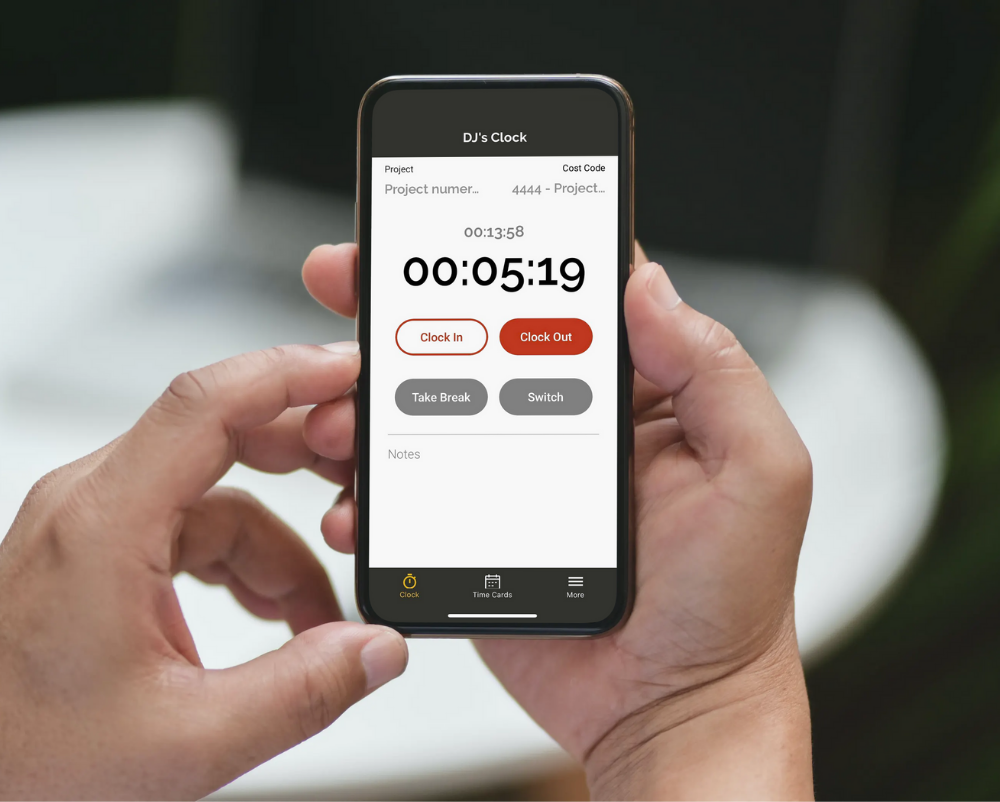
image courtesy of OnTraccr Technologies Inc.

image courtesy of OnTraccr Technologies Inc.

Geofences or GPS locations can be established to ensure employees are in the correct location when they clock in and out. Companies can also log time manually or set up a “shared tablet mode,” allowing employees to clock-in using a 4-digit PIN in a centralized location.

Workers can review their time sheets though the app, make any necessary adjustments, and submit for approval when ready, making it easy to ensure they are paid the correct amount for the time worked.

Using OnTraccr as a Manager

Since time cards are tracked in real-time, management staff can perform budget tracking and job costing functions whenever they want. There are a variety of reports built into OnTraccr that contain valuable data, including:

  • Employee Payroll and Timesheets

  • Budget Tracking

  • Labor Productivity

  • Productivity Forecast

  • Project Timeline and Labor Curve

image courtesy of OnTraccr Technologies Inc.

image courtesy of OnTraccr Technologies Inc.

Each report can be easily filtered by a variety of different categories, such as project, cost code, and approval status, allowing you to quickly find the data relevant to you. Report customizations can be saved for easy viewing later and exported to view, share, and analyze offline.

OnTraccr can even be integrated into QuickBooks or custom enterprise software, allowing payroll to be processed automatically when time cards are approved.

Future Developments

In addition to time tracking, OnTraccr plans to use their app as a means of team communication in the near future.  Since the team will already need access to the software to log and view their time, it’s a natural next step to increase the app’s functionality.  As an example, users will be able to create rooms based upon a specific topic, like RFI or safety conversations. These topic-based chats will keep everyone up to date, further connecting the field and office staff.

The company will also add billing and invoicing for time and material work and an integration into the popular project management software, Procore, as well.

Free Access

With its recent launch, the app is now available across the United States and Canada and the full version can be accessed for free, for life, for up to 4 team members. There’s no better way to find out if an app will work for your team than to see exactly how it works before committing to it.

Above and beyond the first 4 users, pricing is very straightforward at $9.99 per month per additional user.  For enterprises with a large number of users, you can contact their sales team for a cost estimate.

The app is available on both Android and Apple devices and the web app can be accessed through any internet browser.


source https://www.constructionjunkie.com/blog/2021/2/26/ontraccr-is-making-construction-technology-accessible-to-all

Wednesday, February 24, 2021

Crane Collapses on Jobsite in Syracuse, NY, No Injuries Reported

image via the Syracuse Fire Department

image via the Syracuse Fire Department

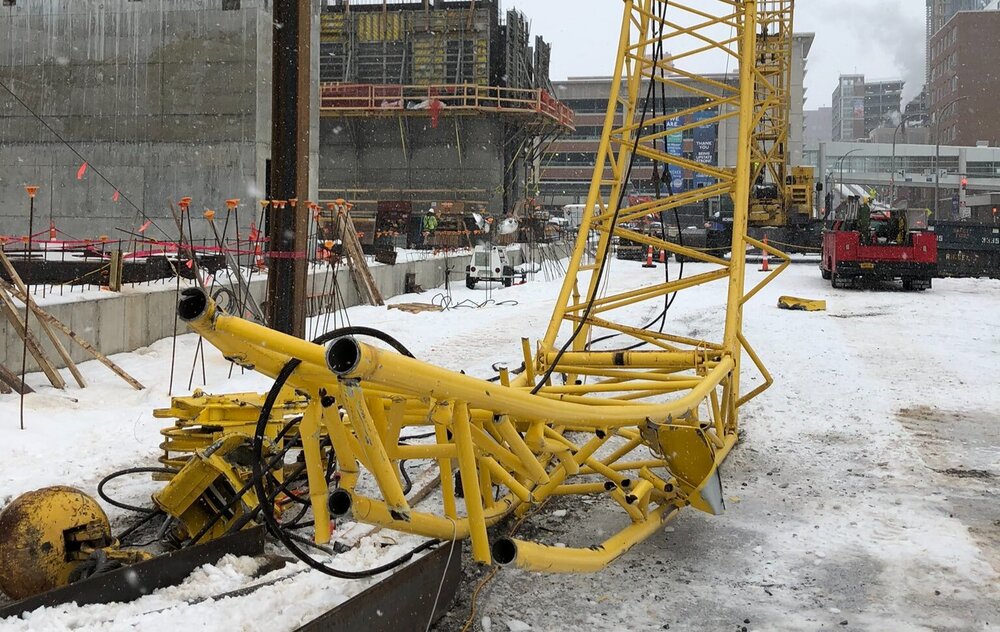
On Tuesday morning, February 23, the Syracuse Fire Department responded to a call about a collapsed crane on a construction site near the university.  Thankfully, no injuries were reported.

According to WIVB, the collapse was first reported around 9am and, once first responders arrived at the scene, they determined that there were no injuries and no buildings damaged. The crane landed within the confines of the site, as well, which will be the future home of a new building at the Upstate Medical University campus.

The piece of equipment is partially obstructed in the photos and videos of the scene, but it appears to be a crawler crane.  At the time of the collapse, the crane was picking some steel off of a flatbed truck.

Syracuse Deputy Fire Chief explained to local reporters that there was no risk to any further tipping or causing any injuries, but the contractors will be making arrangements to get the crane removed from the site.

For more information, you can watch the news report from NewsChannel 9 WSYR Syracuse below:


source https://www.constructionjunkie.com/blog/2021/2/24/crane-collapses-on-jobsite-in-syracuse-ny-no-injuries-reported

Tuesday, February 23, 2021

Finally, an Air-Conditioned Hard Hat is on the Horizon

image courtesy of Feher Research Inc.

image courtesy of Feher Research Inc.

It seems a little odd to be talking about air-conditioning when much of the United States hit some incredibly low temperatures in recent days, but a product that I learned about recently is just too exciting to ignore. Announced at CES 2021, a research company has unveiled an air-conditioned hard hat (ACHH) that can reduce the ambient temperature up to 22 degrees Fahrenheit!

Feher Research Inc. has taken a standard looking hard hat and turned it into the world’s first and only self-contained, portable air-conditioned headgear. This isn’t like a standard A/C unit with refrigerants running through copper lines, though; it uses the Peltier effect, the same thermoelectric technology used to cool the water coolers you might have in your office.

(It’s also similar to the technology used for the Sony t-shirt air conditioners I’ve mentioned before.)

This A/C Hard Hat isn’t backed by some Joe Schmo who just strapped a fan to the back of a hard hat, either.  The inventor of the product, Steve Feher, has been designing and patenting cooling products since the 1960s and created new technologies for cooling car seats that are used by Rolls-Royce, Bentley, Ferrari, Infiniti, Lexus, and GM. He’s also the creator of the Feher Helmet, the world’s first air-conditioned motorcycle helmet.

The Hard Hat can be powered in multiple ways, the most important being through a 3ah lithium ion battery. According to the current specs, this battery will provide 2 hours of run time.  If you work a more stationary job, the hard hat can also be plugged in for continuous run time.

Even with the added components, the ACHH is impressively light weighing in at 18.05 oz with the battery, only about 2-4 ounces more than a traditional hard hat.

image courtesy of Feher Research Inc.

image courtesy of Feher Research Inc.

As far as head protection goes, it will still need to pass ANSI standards in order to work on a jobsite.  The adjustable head band of the hard hat is removed to make room for the components of the cooling system, which is sized like a baseball cap for optimum cooling effect.  Feher believes there are benefits to the construction of the helmet innards though:

“…the ACHH is sized like a hat and covers the users head with a unique air flow structure for maximum head cooling, which also spreads any impact force over a larger scalp area than conventional hardhats that have straps with an adjustable head band” Feher explained, “The conventional straps don't cover the entire scalp, in order to allow the scalp to breathe, so any impact force is transferred to the users scalp with fewer square inches of area than the ACHH, which cover more area and provides sub-ambient air closely to the users head..”

Feher is offering licenses for his technology on an exclusive or non-exclusive basis and the tech will also be available for purchase. 

Is this something that you would be interested to use on your job site?


source https://www.constructionjunkie.com/blog/2021/2/23/finally-an-air-conditioned-hard-hat-is-on-the-horizon

Monday, February 22, 2021

[VIDEO] Volvo Announces Mid-Size Electric Excavator, the EX03

image courtesy of Volvo CE

image courtesy of Volvo CE

To help reduce jobsite noise, exhaust emissions, and reduce maintenance, many construction equipment manufacturers have been busy producing all electric versions of their diesel powered machines, such as the 220+ ton electric crawler cranes that Liebherr recently unveiled. Volvo Construction Equipment is the latest to announce an all-electric machine with the announcement of the midsized, wheeled excavator, called the EX03.

The first thing you may notice about the EX03 is the large video screen on the back of the machine, something that I don’t believe I’ve ever seen before. This screen can serve 3 different functions:

·         A real-time view of the front of the machine, so vehicles trailing behind can see what is up ahead.

·         A text-based screen to help alert workers what movements the machine is going to make

·         A safety communication live stream, which allows the operator to make eye contact with workers and the general public to reduce safety issue

image courtesy of Volvo CE

image courtesy of Volvo CE

Like most of the other electric machines that have been announced previously, Volvo promises that this midsized, 14 metric ton excavator will have the same performance as a similarly sized diesel version. The X03 is currently in the concept stage, so Volvo does not have immediate plans to bring it to market, but it shows the possibilities that electronics on heavy machinery can allow for.

“This prototype is a significant step forward in the evolution of medium electric construction machines. As our first electric excavator concept in the mid-size range, we have been quick to build and expand on our existing electromobility technology. With the same power and force as a diesel machine of the same size, there has been no compromise on performance.”

Check out the short video below, from Volvo, to see the video screen in action:


source https://www.constructionjunkie.com/blog/2021/2/22/video-volvo-announces-mid-size-electric-excavator-the-ex03

Wednesday, February 17, 2021

The Space to Build Podcast Highlights and Inspires Women in Construction

courtesy of Kathryn Hart // Space to Build

courtesy of Kathryn Hart // Space to Build

Podcasting opens the door to listen to and enjoy so many different perspectives from across industry and across the world. I’m absolutely thrilled by the continued growth of podcasting in the construction realm, because it allows us to listen to conversations that we normally wouldn’t have access to, many of which can be extremely important for shaping the future of our industry. One of the newer voices making her conversations heard is Kathryn Hart on her podcast, Space to Build.

Space to Build features one-on-one conversations with other women in the construction industry, who have varying levels of experience and come from many different backgrounds.  Each guest shares their story of how they got to where they are and the path they had to take to get there. Perhaps most importantly, each guest is making a positive impact as a woman in construction.

In an industry where female visibility on the jobsite and in leadership roles can be hard to come by, sharing these stories and normalizing women in construction can not only help open doors for more women to enter and stay in the industry, but also inspire a younger generation to even consider it for their future profession.

So while the podcast features women and their experiences in construction, that doesn’t necessarily mean that it should be isolated to only women listeners.  Men who truly want to know what the female experience is like in the industry could gain a lot from the conversations. The show is also highly relatable to new workers to the industry, as I have found many of the situations discussed to be similar to my own experiences as a relatively young project manager in the industry.

Kathryn herself is a recent college graduate and is currently a superintendent for a general contractor in the Washington DC area. Her desire to create Space to Build came as a result of an experience that she had in her first role after graduating:

“I felt isolated and burnt out not long after graduating. It took a blow up from my then superintendent to wake me up and decide I should take control of my career and find my people,” Kathryn told me, “I found a new company to work for, settled into a good routine, and finally decided it was time to start this community I had wanted for so long. My goal is to create a space that fosters community and professional/personal development for the women new to construction.”

Space to Build recently finished season 1, which consisted of 10 episodes.  Hart says that the episodes have made an impact on other women in the industry, by making them feel less isolated and more motivated. Guests have included project engineers, business owners, a National Masonry Champion, architects, and more. All women making an impact in construction.

Season 2 of Space to Build starts today, February 17, 2021, and Hart told me that she is “excited to dive into the value of building community and what confidence really looks like to women in our industry.”

For more information about the Space to Build podcast, visit spacetobuild.co.  You can also find the podcast on Apple Podcasts, Spotify, Overcast, and Buzzsprout.

You can also check out episode 6 of the podcast, featuring Jennifer Todd, the Founder and President of LMS General Contractors, below:


source https://www.constructionjunkie.com/blog/2021/2/9/the-space-to-build-podcast-highlights-and-inspires-women-in-construction

Wednesday, February 10, 2021

Meet Canvas, the Drywall Finishing Robot Offering Level 5 Quality

courtesy of Canvas

courtesy of Canvas

No matter the industry, robots are highly efficient at performing repetitive tasks.  We’ve seen that firsthand in the construction industry in recent years with the emergence of bricklaying, rebar-tying, and overhead drilling robots. These robots not only offer consistency, but help to reduce muscular-skeletal injuries caused by long term stress on muscles and joints. A newer robot hitting construction sites is Canvas, a semi-autonomous robot that promises to provide Level 5 finish on drywall.

When set up on the jobsite, Canvas has the ability to spray drywall compound on walls and ceilings and provides a dust free sanding system. The human operator navigates the robot to the specific location on-site and sets the parameters of the work to be completed. After that, Canvas goes to work.

“We designed our process so that the robot does things that machines are good at, while our workers do things that people are good at. Robots are great at repetitive, high work; people are great at having the expertise of navigating and negotiating the broader job site, figuring out edge cases, and so on. Workers operate and basically direct the robot, which then automatically performs a lot of the finishing work,” Canvas co-founder and CTO Maria Telleria told me.

The robot not only provides consistency to the finish application, but the programming can be altered to speed up or slow down, depending on what the schedule allows. It also features an on-board dust collection system and sanding arm to reduce cleanup on-site.

Canvas is currently focused on large commercial and new construction projects in the San Francisco Bay Area.  The team has already worked on several high-profile projects, including the San Francisco International Airport Harvey Milk Terminal 1, the UCSF Wayne and Gladys Valley Center for Vision, and the global HQ at Chase Arena Towers.

The company is currently partnering with owners, developers, and general contractors to offer the bot’s services in a subcontractor role, as opposed to leasing or selling the robot outside of the company. The crews that Canvas employs to work with the machine are also union workers.

"We're excited that our partnership with Canvas has developed in the manner it has. It is creating meaningful Union career opportunities, helping introduce previously untapped communities to the trades, and making the work itself safer and reducing the strain on the body," said District Council 16 Business Manager, Robert Williams III, a third-generation Union painter, in a press release. "It's critical for skilled workers to have great resources in their tool kit, and we are excited to be on the leading-edge of technology in our industries by partnering with Canvas."

As with most emerging technologies, though, Canvas is starting small and has plans to branch out in the future. The company only officially announced its public launch in November of last year. The team of founders is made up of some pretty serious technology folks who came from previous roles at Boston Dynamics, MIT, and Stanford. Together, they’ve raised over $19 million from investors to make their current accomplishments possible.

In addition to eventually branching out geographically, the team at Canvas is also learning from their on-the-job experience to make their machine even better.  Currently, the bot is powered by a mix of outlet power and batteries, but they are already working on their next generation platform, which they expect to be completely cordless.

As for pricing, I was told Canvas provides Level 5 quality for the equivalent cost for Level 4 work.

There isn’t much video available of Canvas in action, but I did find a short clip of it sanding, via The Robot Report on YouTube, which you can watch below:


source https://www.constructionjunkie.com/blog/2021/2/9/meet-canvas-the-drywall-finishing-robot-offering-level-5-quality

Tuesday, February 9, 2021

Autodesk Build is Available to All, Combines Capabilities of BIM 360 and PlanGrid

courtesy of Autodesk

courtesy of Autodesk

At last year’s virtual Autodesk University, Autodesk announced a trio of new products: Build, Quantify, & BIM Collaborate.  Build, the platform that combines the features of PlanGrid and BIM 360, is officially available on a global scale as of today.

What is Autodesk Build?

Combining the strong documentation abilities of BIM 360 and the field accessibility of PlanGrid, Autodesk Build is being offered as a complete solution for construction project management, quality control, safety reporting, project cost, and closeout.  While Build does combine these two platforms, Autodesk does not have current plans to stop supporting either existing program or to force those users onto the new platform.

"Our teams need the right technology to achieve outstanding results,” says Barton Malow Holdings Senior VDC Manager Ted Jennings, in a press release. “By bringing together the best of BIM 360 and PlanGrid and adding even more project management firepower, Autodesk Build is both a simple and robust solution. Connecting our teams and data across projects allows us to supercharge our work with more streamlined document, safety and cost management, and deliver on our quality standards.”

Project Management

Teams have the ability to manage and access important information for any construction project, including RFIs, submittals, meeting minutes, and daily reports. Autodesk Docs is also included in the subscription, which is a common data environment (CDE) for the system, creating a single source of truth across all data collected on the project.

Users can also control documents, track versions of drawings, and manage approval capabilities on 2D sheets and 3D models.

Collaboration

Projects can be managed wherever you have access, whether it’s a desktop, laptop, or mobile device.  For field collaboration, Build includes the new PlanGrid Build app, which is based on the stand-alone and industry favorite, PlanGrid. Within the app, users can create and manage punchlists, quality, issues, training, observations, and inspections.

PlanGrid Build also includes compatibility with 3D models.

Cost Management

Build allows users to manage budgets from start to finish, beginning with the creation and contract administration, to change orders, cost forecasts, and payment applications, all in a real-time view format.

Insights

To help mitigate risk on projects, Build also includes Insights, which is an artificial intelligence that helps interpret and export project data, alerting you of potential problems on the project.

More Information

For more information about build, you can check out a demo on their website or sign up for a free 30-day trial.


source https://www.constructionjunkie.com/blog/2021/2/9/autodesk-build-is-available-to-all-combines-capabilities-of-bim-360-and-plangrid